Showing posts with label mindfulness. Show all posts

Friday, 6 March 2015

Mindfulness Neuroscience links

In order to get the correct science-related information for my illustrations of the anatomy of the brain, I did a lot of looking through articles both journalistic and science-based.  Many of them were technical and difficult to summarise here, but others were excellent in summarising the effects and benefits of mindfulness mediations.

"The Power of Meditation and How It Affects Our Brains" by buffersocial

This article is a straightforward, friendly-voiced explanation of the neuroscience behind the benefits of practising mindfulness meditation.  Example: "The overall difference is that our brains stop processing information as actively as they normally would.  We start to show a decrease in beta waves, which indicate that our brains are processing information, even after a single 20-minute meditation session if we've never tried it before."

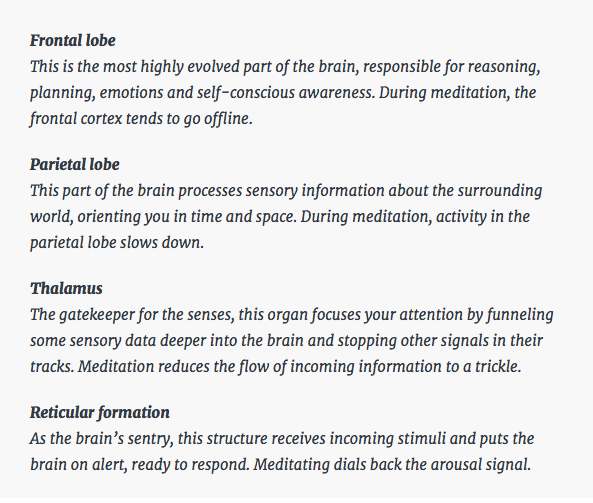
Some screen shots (below) from the article of information I found really useful when creating diagrams of the brain for the app.

Fig 1

Fig 2

Fig 3

"This is your brain on meditation" by Psychology Today

Fig 4

The author describes the emotional part of the brain and the problem solving brain as The Assessment Centre and the Me Centre, which is a way I have not heard of before but I do like enough to borrow the  phrasing for my own stuff!  These terms make it easier for a person reading the neuroscientific information to comprehend what's going on in their heads during the process described. For example, x writes: "If you were to look at people's brains before they began a meditation practice, you would likely see strong neural connections within the Me Centre and between the Me Centre and the bodily sensation/fear centres of the brain…The Assessment Centre's connection to the Me Centre is relatively weak."

"How Meditation Can Physically Change Your Brain"

There's so much here I'm just going to post screen shots!

Fig 5

Fig 6

Fig 7

Fig 8

Fig 9 

References

Fig 1-3.  Cooper, B. 2013. buffer social website "The Power of Meditation and How It Affects Our Brains" [online] Available at: https://blog.bufferapp.com/how-meditation-affects-your-brain
[Accessed 04 March 2015]

Fig 4.  Gladding, R.  2013. Psychology Today website "This Is Your Brain on Meditation" [online] Available at:  https://www.psychologytoday.com/blog/use-your-mind-change-your-brain/201305/is-your-brain-meditation
[Accessed 04 March 2015]

Fig 5-9. Morrice, Gavin. 2013. Thinkers Playground blog. "How Meditation Can Physically Change Your Brain." [online] Available at: http://thinkersplayground.com/how-meditation-can-physically-change-your-brain
[Accessed 05 March 2015]

Mindfulness/Meditation TED Talks

There are an abundance of meditation and mindfulness talks on the TED website, some of which I felt were helpful in my aim to better understand mindfulness so that I can create content that's accurate and covers everything a newcomer might want to know.  This post has been in progress for a while so some  of the information has fed itself in into my designs in places.

Bodhi Kioldije: Meditation: Change Your Mind, Change Your Life

Kiodije is a monk who, naturally, knows best about the benefits of meditation.  Here he is specifically talking about Zen meditation, which is not quite the same thing as mindfulness, but there are some effects of the practice which cross over.  At the start of his talk Kiodije compares the levels of happiness of lottery winners to a group of people suffering HIV, which was compared several years ago in a scientific study.  Those who were HIV positive were happier than the lottery winners.  This is because, as Kiodije puts it, "the mind determines our experience of life".  This leads into the main focus of his talk, which is that: "Where we pay attention will also determine our experience.  Most people don't use this tremendous tool, this flashlight, of how to direct attention."

"It's about detaching from our thoughts.  Our thought are just one aspect of our mind…We need to balance that discriminating function of the mind with this other realm of consciousness that opens up when we learn to detach form our thoughts...Meditation helps you with your whole emotional life by enabling you to detach from your thoughts." This statement outlines the core element of meditation and is something I will draw on when I get to designing the pages of the app which describe what happens to our thoughts when we practice mindfulness, as this is something I've not really looked at in practical work yet.

His explanations of the practice through a metaphor can be helpful to a newcomer who might not be clear on why they should start meditating.  "You shake a snowglobe - this is the condition of the mind before meditation.  And in Zen, we are juts setting that snow globe down, allowing thoughts to settle."

"Consider this as the waves on the surface of the ocean, a lot of turmoil, a lot of buzzing of the mind.  …Many people don't known how much their mind is buzzing all the time, it's like being on the surface of the ocean and just buzzing all the time, and not experience what it is to just get underneath the waves, into the depths of the ocean...When we get under those waves, we experience the unity of things, ands this has tremendous implications."

Shannon Paige: Mindfulness and Healing

Shannon Page spoke of her journey through depression, which was helped by a comination of yoga and mindfulness meditation.  A lot of her talk was about her personal stuff but I managed to clean a few essential bits from it :"Yoga works by accessing the mind-body breath connection." and also, "If we learn to take deeper breaths, we can actually pattern or even re-pattern and heal and move toward wholeness and fullness and wellness." Yoga and mindfulness can go hand in hand, and I have discussed with Simone the possibility of bringing some aspects of depicting a yoga practice in the app, through an illustrative diagram or similar.

Diana Winston: The Practice of Mindfulness

"If you were to look at your mind and kind of examine it, what would you notice?  Your mind is probably in the past or probably in the future.  …So our minds are kind of careening back and forth between these two places.  And in between these two places is where stress lies.  Stress impacts out body, impacts our mind, but it's the mind that takes us out of the present and makes us more stressed out."Diana Watson's talk was an excellent source for me, because her approach to speaking about mindfulness is very similar to the way in which I present it in practical work.  She introduces mindfulness as an easy, accessible thing: "Mindfulness…was something that anybody could do.  Regardless of your background, regardless of where you come from and what your religion is, this practice of paying attention - it's so simple.  Not easy to do, but very very simple."

Watson's talk features many titbits of facts which could help convince a non-meditator to take it up.  For example, she notes that psoriasis sufferers practicing mindfulness healed 3x faster than non-mindfulness practicers.  To echo Mihaly Csikszentmihalyi's findings, Watson tells the audience that people reported being happier if their minds were focused on the present moment rather than being distracted.

With regard to neuroscience, Watson explains that mediation changes the structure of the brain over time.  Studies on long-term meditators brains showed that the meditators brains did not "thin out" or have age-related cortical recline, in the pre-frontal cortex and the insular cortex.  Meditation is directly related to the number of cortical layers in the brain.  After 8 weeks of 27 mins a day meditation, the same brain changes were seen in the novice meditators as those who had been practising for years.  Areas showing the most growth were "The areas related to decision making and flexible thinking, and synthesising information in the body and brain, and connecting self awareness and compassion."

Watson's last point in her presentation is that with mindfulness, we can bring this attention into the present moment and find a place of peace and ease. "We learn it as a meditation practice, we learn it as coming back.  And then we find later on that our mind can be present. And in this way we cultivate more and more ease and more and more wellbeing."

Zindel Siegel: The Mindful Way Through Depression

Zindel Siegel is one of the big guns in the area of mindfulness research, having worked with John Kabat-Zinn, Mark Williams and John Teasedale at Oxford Mindfulness Centre to develop the  8 week MBSR training, based on the model of John Kabat-Zinn..  His talk is about his experience making discoveries in the field and serves as another great introduction to the topic, especially as a combative approach to depression.  "What we were really interested in doing was getting people to create a different relationship with their sadness.  Mindfulness is really the awareness that comes to mind when we pay attention in a particular way, we are bringing our attention to the present moment and we are not judging what we notice."

"MBSR tries to work with concrete examples of how to pay attention and how to be mindful."  Siegel notes the examples of holding and "investigating" a raisin, and other introductory exercises which get people used to thinking about physical sensations and focusing on them further. These exercises will actually be featured in the app I am creating as a way of creating stickiness, which I have spoken about in previous posts.  Of the exercises, Siegel says: "What we are trying to get people to do is to anchor themselves in their experience so that when a negative emotion comes up in the mind it can wash over them…they can find a different place for standing and working with these feelings.  And as a result, have much more of an option for sleeting a response and for influencing what happens next."

Also mentioned is the sister therapy of MBSR, MSCT (Mindfulness Based Cognitive Therapy), which reduces the risk of a  relapse into depression by about 40%, and equal relapse prevention to continued medication. "It enhances people's ability to feel reward, to feel positive affect, in their daily lives…the capacity to reward and to feel reinforced for mindfulness allows these health benefits to continue." I plan to detail these techniques in the same section of the app that deals with the introductory exercises (under the "How To Get Started" umbrella).

So why is this? "People are better able to tune in to the state of the body…what we are finding is that as the present moment pathway gets activated people trained in mindfulness are able to increase the activation in the insula, more than people who haven't been trained.  It turns out this is vitally important for working with sad mood states."  Through mindfulness, the person feeling sad has access to two pathways: Executive control network vs. the present moment pathway.  This pathway is desrcibed by Siegel as "...an inner resource that allows them to take care of themselves in a way that touches greater moments of wholeness…it becomes less about a treatment and more about a way of life and looking after themselves."

Susan Kaiser Greenland: Teaching the ABC's of Attention, Balance and Compassion

Susan Kaiser Greenland speaks about mindful awareness in schools.  She believes that if we start teaching mindfulness to children as young as five, the next generation will grow up with tools to deal with their busy stressful lives and learn how to better handle certain health conditions too.  Greenland's emphasis is on attention and what kind of attention we are paying to ourselves. "What is the quality of my attention?  Is my attention sleepy, is it drowsy and dull?  Or am I alert and really wide awake?  Or is there a bias to my attention?"

"The two strategies with attention are really focusing and choosing.  The repeated focusing of attention on one object over ad over again does change the brain...When you focus on one thing and nothing else, a corresponding part of your brain will get bigger."  Greenland notes that taxi drivers have a bigger part of the brain associated with navigating geographical spaces than other people - the same applies to regular mindful meditators.

The next question she raises is how we are to balance our attention. "Balance is associated with quieting and seeing.  mindfulness is really not about changing…or trying to fix emotions, or hide emotions or put them under the rug.  It's about noticing them and being able to turn in and look at them, with the intention to understand and not to judge."

Similar to Siegel's analogy above, Greenland talks of the emotional part of the brain vs the problem solving part.  "When the emotional part of the brain gets loud, it's really hard for the problem solving part of the brain to do its work.  What mindfulness in adults does is it moves the problems from the emotional part of the brain to the problem solving part." This also works in reverse.

Greenland also has something to say about the effect of compassion levels in mindfulness practitioners, which is something I have toyed with bringing in to my information visuals.  "In compassion, caring and connecting are the two parts.  If you develop the ability to empathise with more people, that part of the brain in the nervous system gets stringer and you can better understand yourself.  It works the other way around too, the more introspective you are…the stronger your ability to understand other people." So, mindfulness literally makes you nicer!


References

Kaiser Greenland, Susan.  2012.  "Teaching the ABCs of Attention, Balance and Compassion." [online video] Available at: https://www.youtube.com/watch?v=LpMvTTIr2p4
[Accessed 07 February 2015]

Kjolhede, Bodhin. 2013. "Meditation: Change Your Mind, Change Your Life." [online video] Available at: https://www.youtube.com/watch?v=upNONoxskiw&spfreload=10
[Accessed 07 February 2015]

Paige, Shannon. 2012. "Shannon Paige - Mindfulness and Healing." [online video] Available at: https://www.youtube.com/watch?v=UcGUo6uNs34
[Accessed 07 February 2015]

Winston, Diana. 2012.  "The Practice of Mindfulness." [online video] Available at: https://www.youtube.com/watch?v=oMlaSCxZPN4
[Accessed 07 February 2015]

Segal, Zindel. 2014.  "The Mindful Way Through Depression." [online video] Available T: https://www.youtube.com/watch?v=1A4w3W94ygA
[Accessed 07 February 2015]

Further watching:

Siegel, Daniel. 2012.  "Mindfulness and Neural Integration: Daniel Siegel, MD" [online video] Available at: https://www.youtube.com/watch?v=LiyaSr5aeho
[Accessed 07 February 2015]


Saturday, 7 February 2015

Mindfulness' Effects on the Brain

I have been very quiet on here for over two weeks, however I have been working nonetheless! At the moment I am drafting out illustrations to be featured on the webpages and trying to make them non-textbook-sciency, as is seen in a lot of art which is used to explain mindfulness (more on that later). While doing research for an illustration about mindfulness' benefits to the body, I found this article, which is an ideal introduction to the science-led side of things.  Last week involved a lot of reading up on mindfulness and meditation in science journals online, and the language was typical of a science paper so at times was hard to grasp.  By contrast, this article by Scientific American explains the concept in a very straightforward way and covers the neurological effects as well as psychological, which I love (at times the biological side of mindfulness is a complex one to digest if you're not familiar with neurology terms).   In time I will write up my findings from the science journals, but for now the article would be a great introduction to the science writings for anyone following this blog.

"Now, as the popularity of mindfulness grows, brain imaging techniques are revealing that the ancient practice can profoundly change the way different regions of the brain communicate with each other - and therefore how we think - permanently." (Ireland, 2014).  The article covers the main benefits of practising mindfulness meditations for both the brain's neuroplasticity and the body's reaction to stress and some physical ailments and diseases, generally making a very strong case for the practice of mindfulness to remedy them.  I won't go into depth about it as it is an article that doesn't really need extra elaboration, but I can note that the closing quote of the article really summed up part of my own approach to mindfulness within this project.

"Perhaps its new-age, quasi-spiritual connotations of meditation that have so far prevented mindfulness form being haled as an antidote to our increasingly frantic world.  Research is helping overcome this perception, and ten minutes of mindfulness could soon be an accepted, stress busting part of our daily health regimen, just like going to the gym or brushing our teeth." (Ireland, 2014)

As I said I am currently working on a bunch of illustrations and roughing out the content of the website prototype, so I hope to post about those in the coming week.  Until then, give the article a read!

References:

Ireland, Tom. 2014. Scientific American website. "What Does Mindfulness Meditation Do To Your Brain?" [online article] Available at:  http://blogs.scientificamerican.com/guest-blog/2014/06/12/what-does-mindfulness-meditation-do-to-your-brain/

[Accessed 07 Feb 2015]

Thursday, 22 January 2015

Mindfulness Apps - Meditation Helper, The Mindfulness App and Enso

This post is part 3 of the mindfulness apps blog posts.  Here I write about apps that are specifically geared towards meditation in their design and visuals. 

Meditation Helper 

Meditation helper is a very barebones app but I thought it important to feature nonetheless as it was listed as a useful one.   The premise is pretty simple - the user sets a timer for bells to ring at the start and the end of meditation.  The bell is a well-known mediation aid, as the sound is natural and fades out slowly which forces the listener to focus hard on the sound.  Usually a breath is taken three times during the ringing of the bell, so it is a starting point for the meditation.  

I can't say I love the interface here as it is not visually appealing at all.  However, the point of the app is to help the user meditate, so it would follow that there is no use for images or well-chosen text.

The Mindfulness App by MindApps

This app is streamlined to focus just on meditation, without much extraneous information as seen in Headspace and MentalWorkout.  The interface is really suited to smartphones with much of the same type and similar menus designs to the iPhone interface.  The header type is slim but because the letters are tall it reads easy and appears kind of gentle.  This app is more suited to people who are aware of mindfulness meditations and the benefits they bring, hence the minimal approach.  I don't see my own work following this look as a whole, although that glowy dotted circle on the blue background is really relaxing to look at!


Enso

Enso is much like the apps above, but a lot more pretty in design in my opinion.  It is designed to work well with the iPhone interface in particular, with similar on-off sliders and breaking up of sections.  What I really like is the way the timer is set up and presented (middle and right screenshots) - much more visually fitting than a timer countdown.  The simple, sleek visuals are something I hope I have time to explore too, because while I'm taken with the personable, quirky visuals as shown in the Headspace app, I also think there is potential to create something that is very stylish as it may appeal to the target 18-35 market who would perhaps like their apps to feel "grown up".


References

Kazmucha, Allyson. 2014.  Imore website. "Best meditation apps for iPhone: Clear your head and relax better than ever!" [online] Available at:
http://www.imore.com/best-meditation-apps-iphone-omvana-headspace-breathful-and-more
[Accessed 19th Jan 2015]

Unknown, 2014.  iTunes website. "The Mindfulness App" [online] Available at:
https://itunes.apple.com/gb/app/the-mindfulness-app/id417071430?mt=8
[Accessed 19th Jan 2015]

Tlaka, Stephany.  2014.  Mindful website. "Mindfulness: Apps for That?" [online] Available at:
http://www.mindful.org/mindful-magazine/mindfulness-apps
[Accessed 19th Jan 2015]


Thursday, 15 January 2015

First week of uni update - meeting with Dave and change in direction

After a week of lots of reading and thinking (and more thinking) about where on earth I was going to take my project, I have finally found a bit of direction.  On Thursday last week I met with Dave, and explained to him my situation of feeling a bit lost and not too sure of how I could take my project further.  He suggested taking a step back and looking at the things I was interested in, leading to the decision to focus on the relationship between image/illustrations and typography.  At first I was very sceptical of focusing on this, as at face value the topic seemed a bit simple compared to all these big, lofty ideas I had been exploring last semester.  However, after thinking about it for a few days and weighing it up against my other idea of exploring humour in design (see previous post), my gut feeling won out and I chose to explore image-type relations.  At the moment I am reading up on anything I can find to do with this, including books such as "Reading Images:  The Grammar of Visual Design" by Gunther Kress and Leo van Leeuwen and some great articles on typography which I will write about in another post.

Of course, then I had to think about what my honours project would actually be.  For a while now I have been drawn towards doing a graphic design project on mindfulness, but I had always been hesitant to go for it because I was worried people would think the topic was not interesting or a bit weird.  Mindfulness is a great practice to get into to manage stress and anxiety and has been proven time and time again to be an effective tool for the long-term management of depression.  However, as it stems from Buddhism and is generally linked to other "new age" practices, people are often put off by it and for the very same reason, I didn't really feel like it was "cool" enough or "out there" enough to be considered a good topic.

Then it hit me - since I had been so interested in design as a persuasive tool, mindfulness was a perfect topic for an hours project.  If people were already put off by the practice due to preconceived ideas, then surely this would be a great opportunity to try and use everything I was looking at to turn that around and present mindfulness in a way that would spark an interest in people and "show it off".  There is a lot of scope, both in the visuals and text and how I can go in a different direction from the typical outdoorsy, body-mind-spirit look that tends to accompany information on the subject.

Having a look at what is currently out there on mindfulness as a starter helped me to see that there was potential in my proposed idea.  The ones on the website for Mindfulness Scotland confirmed that what was already out there could be improved to look more appealing, dynamic, and personable, which I feel is one of the most important factors.  Looking at the way all the information is presented here, it looks quite lacklustre and some of the information which could be a "selling point" if you like is presented among a wall of text which many people might skim over or not want to read at all.   Overall, the mix of type and image is not the most effective - Myriad Pro is fine for a body type as it is legible, but for the header ("Mindfulness Scotland: Enhancing the well-being…") it ends up conveying the practice as very solemn and serious.

Fig 1 Screengrab from Mindfulness Scotland page

Figures 1 and 2:  There are some good quotes on these pages which could be a strong point of encouragement for newcomers, but they get lost in the layout because their font kind and size is consistent with the rest of the page.

Fig 2 - Screengrab from Mindfulness Scotland
Below:  The list of benefits from practising mindfulness are listed below, but there is nothing on the page to highlight these except some ordinary bullet points.
Fig 3 - Screengrab from Mindfulness Scotland website

The Mindful website is a little more dynamic in layout and use of text and imagery, consequently making the page a little more exciting to the eye.  For starters there is a nice calming mix of colours in there with the blue and hints of orange, which contrasts nicely.  The site uses a mix of stock photography and illustrations to go with articles, which works well as .  However as you can see at the bottom of this screengrab, there are still the usual landscape/meditation pictures associated with mindfulness there.  I realise that I may not be able to shake these off completely as the practice of meditation is intrinsic to mindfulness, however I am keen to get away from these "typical" images as I feel that sometimes this is what puts people off.

Fig 4 - Screengrab from Mindful.org

I noticed that the NHS Moodzone page is rather similar - blue has been found in colour theory to produce a calming effect and so is being used here to do so, with the added benefit of being a good colour choice for screen design.  The site is a place, primarily for younger people, to go for advice and resources to deal with stress and anxiety.

Fig 5 - Screengrab from NHS Moodzone

The Be Mindful page takes a different approach, with brighter, warmer colours and chunky typography which gives it a more vibrant look.  The site is run in association with the Mental Health Foundation in the UK, who present the information related to mental health in a way that is visually interesting.  The type in particular appears to be what I feel is "personable", as the edges are rounder giving it a softer look than if it were a regular sans-serif.  This kind of font would also be the kind that would catch the attention of a younger crowd, who are a target audience for the Foundation as one of their aims is to educate young people on the effects of mental ill health.   

Fig 6 - Screengrab from Be Mindful page

Fig 7 - Screengrab from Be Mindful page

This combination of image and the aforementioned "friendlier" type speaks to people of all ages.  The use of photography means that the situation described in the poster appears as a realistic, serious issue, and as people are drawn to what they recognise as their own, the girl's face acts as an "anchor" for both the viewer's gaze and emotions.  The thumbnail illustrations at the side are simple but almost feel playful.  Overall I feel that, through the combined use of imagery and typography, this page says that the Foundation are open-minded, welcoming and to the point about the facts surrounding mental health.
Fig 8 - Screengrab from Mental Health Foundation homepage

My next area of study will be reading up more on image-text relationships as well as looking at more existing materials on mindfulness and mental health.  I had a good meeting with my supervisor Simone who gave me some advice on what to look at next, so I will write more on that in an upcoming post.  

References:

Fig 1 - Mindfulness Scotland, 2014. Mindfulness Scotland Homepage [online] Available at:
http://www.mindfulnessscotland.org.uk/?doing_wp_cron=1421324398.0654509067535400390625
[Accessed 14th January 2015]

Fig 2 - Mindfulness Scotland, 2014. Mindfulness Scotland Homepage [online] Available at:
http://www.mindfulnessscotland.org.uk/?doing_wp_cron=1421324398.0654509067535400390625
[Accessed 14th January 2015]

Fig 3 - Mindfulness Scotland, 2014.  The Benefits of Mindfulness [online] Available at:
http://www.mindfulnessscotland.org.uk/benefits/
[Accessed 14th January 2015]

Fig 4 - Mindful, 2015.  Mindful Homepage [online] Available at:
http://www.mindful.org
[Accessed 14th January, 2015]

Fig 5 - National Health Service, 2014.  NHS Moodzone [online] Available at:
http://www.nhs.uk/conditions/stress-anxiety-depression/pages/low-mood-stress-anxiety.aspx
[Accessed 14th January, 2015]

Fig 6 - Mental Health Foundation, 2014. Be Mindful Homepage [online] Available at:
http://bemindful.co.uk
[Accessed 14th January, 2015]

Fig 7 - Mental Health Foundation, 2014. About MBSR [online] Available at:
http://bemindful.co.uk/mbct/experience-mbct/
[Accessed 14th January, 2015]

Fig 8 - Mental Health Foundation, 2015. Mental Health Foundation [online] Available at:
http://www.mentalhealth.org.uk
[Accessed 14th January, 2015]